With Summer soon coming to a close, I want to take a moment to recognize some of my undergraduate researchers, and their graduate student advisors!
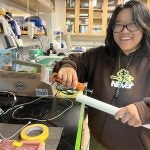
First, I want to give a shout-out to all the undergraduates who joined my group in Winter/Spring 2025 as part of the Larvae League to contribute to our NSF CAREER project. Many of these students graduated this year (congratulations!). I formed the Larvae League to engage a medium-sized cohort of undergraduate students in research after their course-based undergraduate experience (CURE) in my class, ECI 140A. The goal of the team was to support field- and laboratory testing of the bioconversion of organic wastes by black soldier fly larvae (BSFL). We organized into three sub-teams (Field team, Lab team, and Arduino Allstars) with one student project-manager leading meetings and documentation (thank you, Kristen Wojciechowski, for being an excellent project manager, and for being quick to volunteer for the role!).
Graduate student Delbert Truong (MS) and Postdoctoral scientist Wenting Li guided the team in learning about and conducting lab and field experiments, with PhD student Jack Bartlett subsequently taking on a mentorship role for the team. Alyssa Duong, Savannah Villalobos, and Rebecca (Becky) Mulato developed an Arduino-controlled scale that could be used to collect continuous data on weights (useful for multiple projects). At the same time, Alyssa contributed significantly to developing education materials for the Larvae League, building off of curriculum developed by former Masters student Eduardo Baptista de Siqueira. Along with Savaannah and Alyssa, Oscar Babar was a part of the design/build team for the field experiments with bioreactors. Alyssa came back in the next academic year to work with Jack and incoming undergraduate student researcher, Miles Kim, in building reactors for larvae bioconversion experiments. Kallan Arimura, Sama Alsomiei, and Aidan Lovato rounded out the lab team to work on methods for substrate characterization. Kallan was especially inspired to continue laboratory investigation for nitrogen recovery throughout the following academic year. The Larvae League really was a team effort, and we accomplished much together!
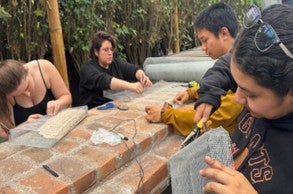
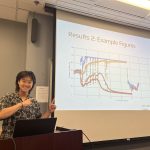
Next up, I want to thank all those on our research team who collaborated with Mosan, a sanitation and resource recovery NGO doing amazing work in regenerative agriculture and sustainable sanitation in Guatemala. Amongst their activities, Mosan creates valuable products from wastewater sludge and dry toilets. The goal of our collaborative project was to accelerate drying processes for a urine nutrient recovery system established by Mosan. Delbert Truong worked closely with staff at Mosan for two years during his Masters program in Environmental Engineering and advised many undergraduate students along the way. We were supported by a seed grant from Global Affairs at UC Davis. Several of the undergraduate researchers on the project got started in our group as part of the Larvae League. In 2025, Delbert led a team of undergraduate student researchers that included Becky and Savannah as well as Nika Self, who had recently graduated and previously contributed significantly to our NSF CAREER project as an undergraduate researcher. The team travelled to Guatemala to conduct field tests to evaluate the incorporation of ceramic zeolite drying beads into the urine resource recovery pipeline. Kallan then worked closely with Delbert back at UC Davis in the lab on extensive testing ceramic zeolite drying beads to accelerate drying processes (and presented to our Bischel group meeting!).
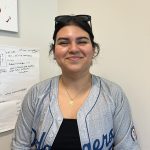
Angela Rios and Qikai Liu also contributed to several projects during their time as an undergraduate student researchers in our group. Angelica first joined the group in Winter 2025 as part of the Larvae League research team, while Qikai joined our group in Fall 2025 to support a first-year, hands-on seminar that I co-taught with Dr. Mimi Jenkins on point of use water treatment in developing countries.
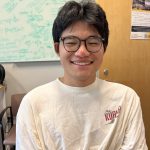
Qikai helped assemble biosand filters that we were to test with students using river water, and trialed E. coli testing methods. Angelia and Qikai later transitioned to an exploratory project related to PhD student Kara Stuart’s research on water access and quality in Mali. In the lab, Angelica and Qikai were guided by Environmental Engineering Masters student, Winston Bess, to develop 3D-printed equipment in support of rapid, low-cost E. coli testing. This process included prototyping iterations of a reusable filtration manifold using Fusion 360 CAD software (and frequent brainstorming sessions!). They also compared E. coli results against CompactDry ECO plates. Angelica noted, “Through this work, I have learned key concepts in prototyping, low resource methods, and reviewing research protocols for public health related projects. While the project continues after my time in the lab, I am grateful for the experience I have gained.”
I send my best to all of our graduating students (keep in touch!), and I look forward to continued collaboration with those staying on with our research team this year.